Tímea Laura Molnár is an Assistant Professor in Economics at Central European University (CEU) in Vienna, a Research Affiliate at IZA (Institute of Labor Economics), and a Research Fellow at RFBerlin (Institute for the Economy and the Future of Work). She holds a PhD in Economics from the University of British Columbia (UBC). She is the recipient of the 2018 Dissertation Award from the Human Capital and Economic Opportunity (HCEO) Working Group (University of Chicago).
Using quasi-experimental methods and field experiments, her current research focuses on gender gaps, mothers' labor market sorting after childbirth, educational and childcare policies, and the long-run impacts of early childhood investments. Her work is published in the Journal of Labor Economics, Journal of Human Resources, Journal of Health Economics, and Canadian Journal of Economics, and has been presented at NBER, SOLE, EEA, EALE, and other leading conferences.
At CEU, Tímea teaches Labor Economics, Economics of Education, Introductory Microeconomics, and Applied Econometrics at both the undergraduate and graduate levels. She is the recipient of the 2024 Best Teacher Award in the MA in Economic Policy in Global Markets program at CEU and was nominated by a group of students for CEU's (University-wide) Teaching Excellence Award in 2025.
After her PhD, Tímea worked for three years as an Associate at Analysis Group in Montreal, supporting academic experts in litigation cases on healthcare competition and labor market discrimination.
Does Earlier Return to Work Help Mothers' Career? Evidence via the Substitution Effect of Parental Leave
with Anikó Bíró (ELTE KRTK), Lili Márk (CEU), Zsigmond Pálvölgyi (Corvinus U of Budapest)
May 2026 Revise & Resubmit
To see if earlier return to work after childbirth helps mothers' careers, we exploit a Hungarian policy reform that allowed mothers to keep maternity benefits even if they resumed work before their child turned two, creating a financial incentive to return earlier without reducing benefit levels. Such a unique setting enables us to isolate the Substitution Effect inherent in paid parental leave. Using a Triple-Differences Event Study design and administrative linked employer--employee data, we compare the outcomes of mothers who were eligible and ineligible based on the timing of their child’s birth, pre- and post-birth, relative to childless women. We find a 3.1 percentage point (31 percent) rise in employment 19–24 months after childbirth, with no effects on later births or long-term employment. We find positive wage effects and/or sorting into higher-paying firms 3--5 years after childbirth for the groups of mothers who were more likely to work in months 19--24, e.g., for those who gave birth after age 30, worked in white-collar jobs, had above-median wages, or were employed at higher-paying firms. Yet, most women also sort into less managerial occupations with lower time pressure. Thus, earlier return also shapes mothers’ careers by influencing the types of roles and firms they sort into.
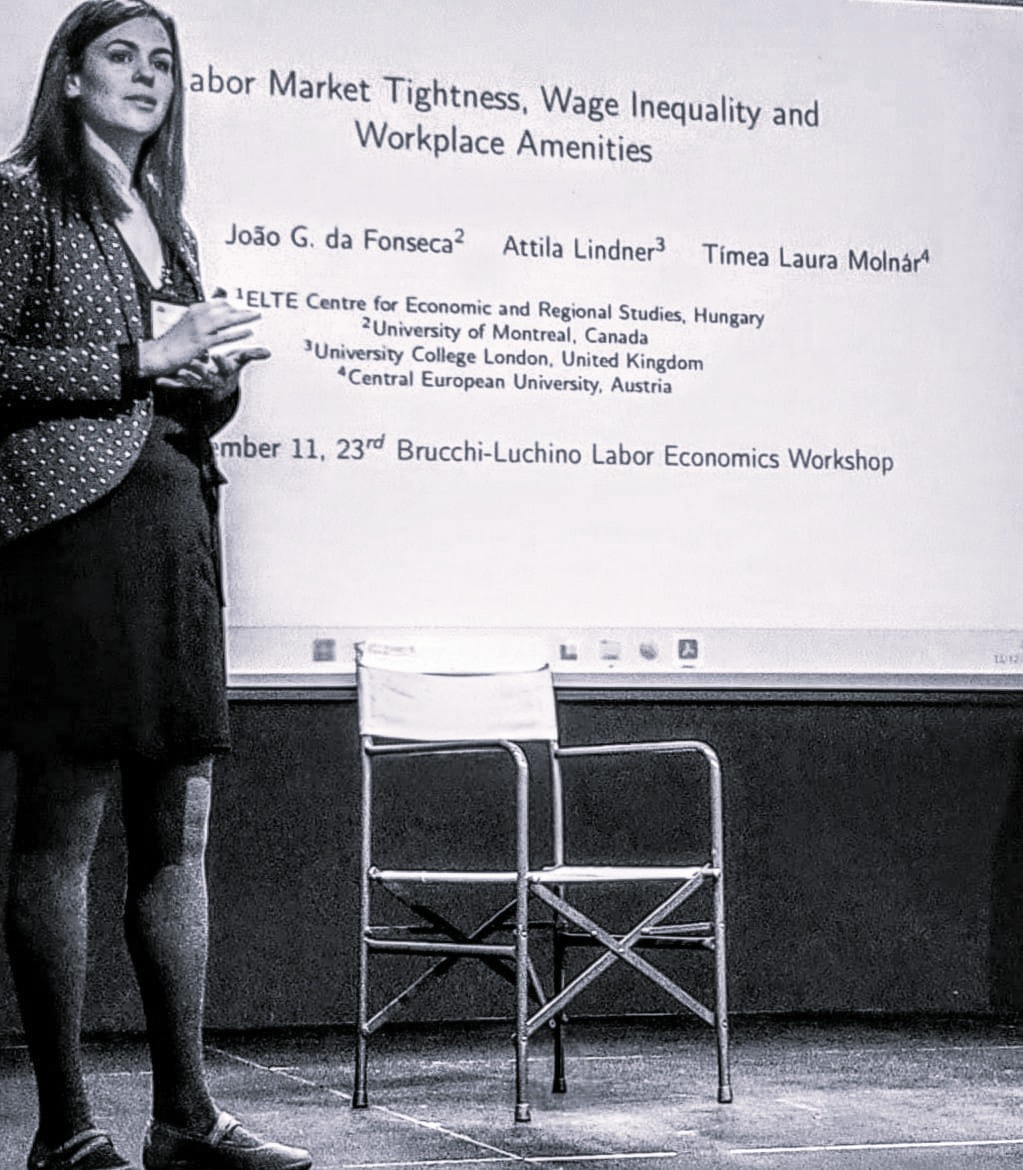
Labor Market Tightness, Wage Inequality and Workplace Amenities
with Anikó Bíró (ELTE KRTK), João G. da Fonseca (U de Montréal), Attila Lindner (UCL)
June 2026 Submitted
We study how compensating wage differentials vary with labor market tightness. Using administrative data from Hungary, we construct a firm-level measure of injury risk as a proxy for workplace disamenities and estimate a marginal willingness to pay for this amenity of 5%. We show that compensation for this workplace disamenity is strongly cyclical. As labor markets tighten, the wage premium at high-injury firms rises significantly. A five percentage point decline in the unemployment rate increases compensation by 1.1%, equivalent to about 20% of the marginal willingness to pay of the amenity. Despite this, high-injury firms experience persistently higher separation rate, indicating that workers are undercompensated in slack labor markets and reallocate toward higher amenity jobs as labor market tighten. Tighter labor markets widen wage differentials by increasing compensation for disamenities, while reducing utility dispersion across jobs at the same time.
When Mathematics Rank Matters: Dynamic Peer Comparisons and the STEM Gender Gap
with Zsuzsanna Vadle (CEU) and Zoltán Hermann (ELTE KRTK and Corvinus U of Budapest)
July 2026 Submitted
We shed light on the STEM puzzle – boys being overrepresented in STEM fields although girls outperform them in school – by studying dynamic rank effects by gender on mathematics-related outcomes: when students enter a new high school class, does the effect of their primary-school rank persist or does their new rank supersede it? We use unique Hungarian administrative data in which the same student is observed among all their classmates in both primary and secondary school. We compare the effect of mathematics rank among primary-school classmates at the end of Grade 8 with that of among new high-school classmates in Grade 9, fixing Grade-8 score. Our design separates persistence of earlier rank from updating among new peers. We uncover a novel gender asymmetry for the timing of rank signals: later rank matters relatively more than earlier rank for girls, and the opposite holds for boys. For boys, underrepresented in the fierce academic high school track, primary-school rank drives STEM choice, indicating the “big-fish-little-pond” mechanism. For girls, overrepresented in the academic track, only high-school rank drives STEM choice, suggesting that girls need a strong positive signal in a competitive environment about their mathematics abilities to choose STEM. Thus, higher mathematics high-school-class rank for girls may reduce the STEM gender gap. Suggestive evidence points to mechanisms of less anxiety and stronger self-esteem for girls and more internal Locus of Control for boys.
The Distribution of COVID-19 Related Risks
with Patrick Baylis, Pierre-Loup Beauregard, Marie Connolly, Nicole M. Fortin, David A. Green, and others
Canadian Journal of Economics (54), 2022 — Special Issue: The COVID-19 Pandemic
We document two COVID-19–related risks, viral risk and employment risk, and their distributions across the Canadian population. The measurement of viral risk is based on the VSE COVID-19 Risk/Reward Assessment Tool, created to assist policy-makers in determining the impacts of pandemic-related economic shutdowns and re-openings. Women are more concentrated in high-viral-transmission-risk occupations, which is the source of their greater employment loss over the first part of the pandemic. They were also less likely to maintain contact with their former employers, reducing employment recovery rates. Low-educated workers face the same viral risk rates as high-educated workers but much higher employment losses. This is largely due to their lower likelihood of switching to working from home. For both women and the low-educated, existing inequities in their occupational distributions and living situations have resulted in them bearing a disproportionate amount of the risk emerging from the pandemic. Assortative matching in couples has tended to exacerbate risk inequities.
Primary School Reopenings and Parental Work
with Pierre-Loup Beauregard (UBC), Marie Connolly (UQaM), Catherine Haeck (UQaM)
Canadian Journal of Economics (54), 2022 — Special Issue: The COVID-19 Pandemic
In this paper, we exploit the geographical pattern of primary school reopenings during the COVID-19 pandemic in Canada to estimate the impact of school reopenings on parental employment and work hours. We use a triple-difference approach, in which we first compare parents of primary-school children in regions where schools reopened to similar parents in regions where schools remained closed and add parents of older, secondary-school children as an additional control group. We estimate the impact of school reopenings separately for mothers and fathers, and for single parents and parents living in dual-parent households. We find a positive impact of school reopenings on employment and on actual hours worked. The effects tend to be stronger for single mothers, but are also present for mothers and fathers in dual-parent households in the spring of 2020. Overall, single mothers experienced an 18 percentage point increase in their employment at work rate following school reopenings. We also split our sample according to whether the job can be done from home, and find stronger impacts for those whose jobs cannot easily be done from home.